
Alexandre is currently the marketing director, but he previously worked as an architect specializing in BIM.



Redraw vs V-Ray: real cost, render time and quality. Why architects are replacing V-Ray with AI rendering in 2026.
Redraw
Start transforming your projects today using Redraw.



V-Ray dominated rendering for years. Together with Corona Render, they were the only options for anyone who wanted hyper-realistic results. No other render engine came close. Those working with high-end architecture, competitions or commercial visualization had no choice: it was V-Ray or nothing.
But all of this had a price. And I'm not just talking about the license.
To master V-Ray, a professional needed years of study. There are over 1,000 parameters that, combined correctly, deliver that level of photorealism everyone recognizes. Materials, global illumination, caustics, GI, sampling. Each render is an engineering feat.
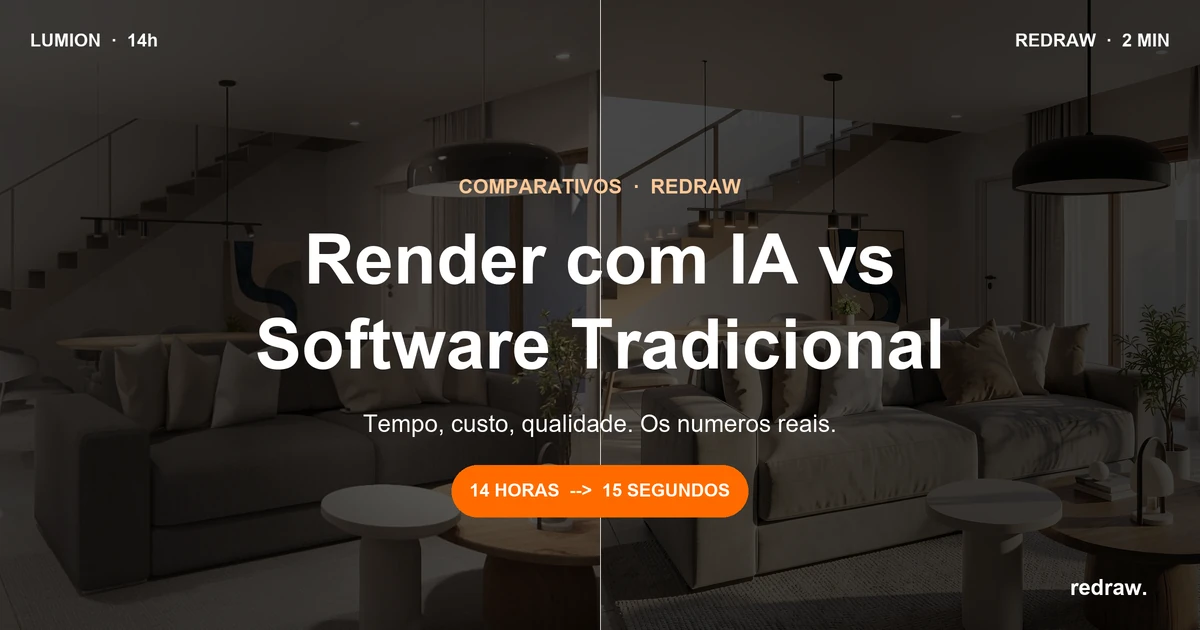
Render time has always been a problem too. A V-Ray render can take 1 to 8 hours depending on the scene, resolution and hardware. That's 3 times longer than software like Lumion or Enscape. And during that time, your computer is locked.
Speaking of hardware: to run V-Ray with quality, you need a serious machine. Powerful multi-core CPU, 32 GB+ RAM, dedicated GPU. An adequate setup costs between $3,000 and $8,000.
The V-Ray Solo license costs $540/year. That seems "ok" until you add that V-Ray is a plugin. It doesn't run on its own. It needs SketchUp, 3DS Max, Rhino or Revit underneath. So you pay the V-Ray license plus the host software license. That's two subscriptions.
Chaos Group itself realized this model was losing ground. Simpler software like Lumion and Twinmotion were stealing market share, even while delivering inferior results. Their response? They bought Enscape. They tried to apply Chaos technology to something faster. They acknowledged the problem without saying it out loud.
The turning point came when AI tools started delivering satisfying results in seconds. Redraw was a pioneer in this movement: AI rendering trained specifically for architecture.
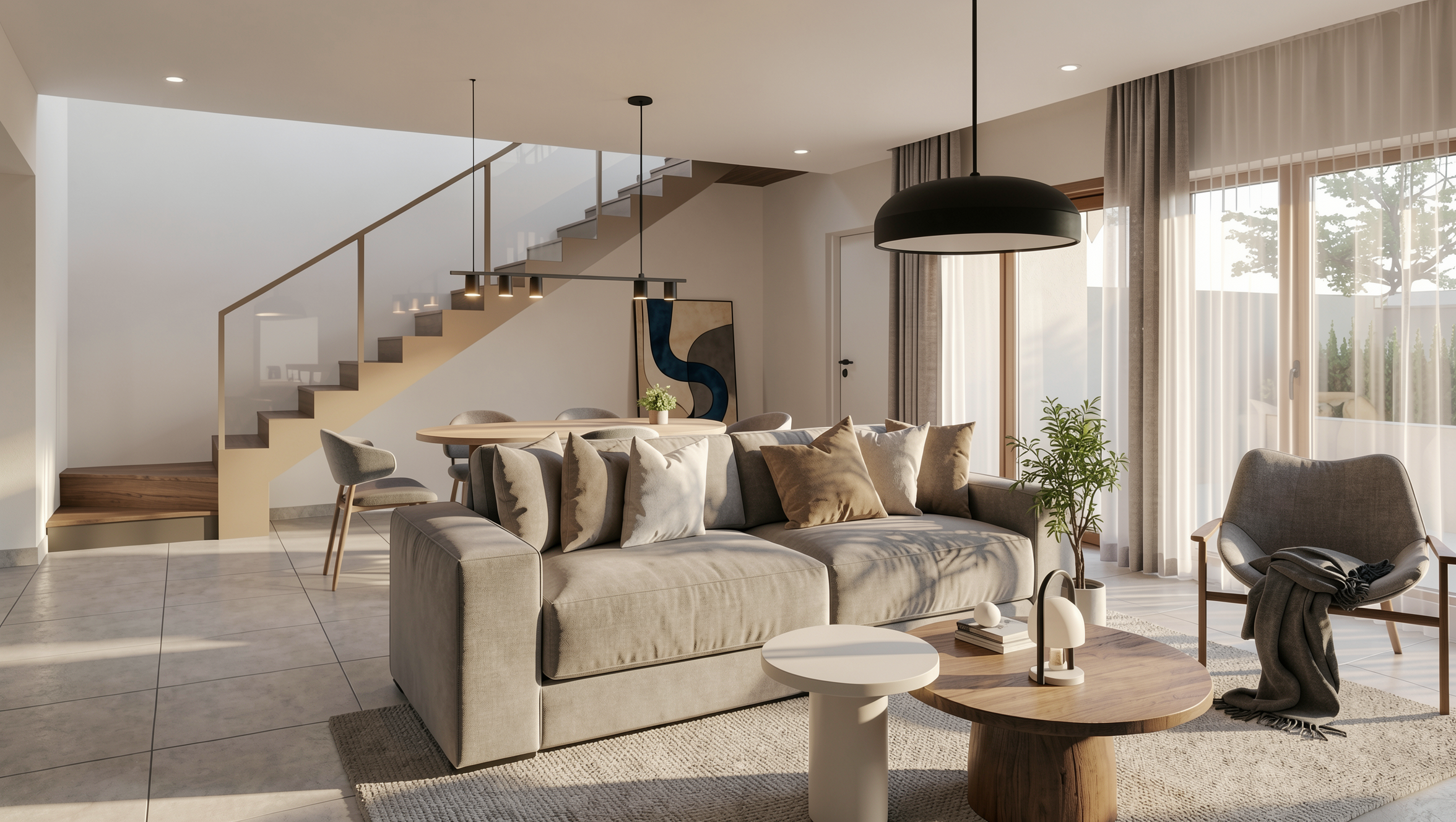
At first, AI quality didn't come close to V-Ray. That's true. But it evolved fast. Today, the results are hyper-realistic and maintain fidelity to the original project. Proportions, geometry, materials. The AI doesn't invent. It renders what you designed.
And it does this in 20 to 40 seconds. No configuration. No expensive hardware. No years-long learning curve.
Work that used to take a week between modeling, setting up materials, adjusting lighting and rendering is now done in under 10 minutes with AI. That's not an exaggeration. It's the real workflow of those who use it.
Take an architect who delivers 8 projects per month, with 4 renders each. With V-Ray, each render takes an average of 2 hours including setup and processing. That's 64 hours per month just rendering.
With Redraw, the same 32 renders take under 20 minutes total. That's 63 hours given back per month.
In cost:
V-Ray: $540/year (V-Ray) + $349/year (SketchUp) + amortized hardware (~$1,000/year) = ~$1,889/year
Redraw: $384/year (Expert plan) + zero hardware = $384/year
Difference: over $1,500 per year. And 63 hours per month.
If you've invested years learning V-Ray and have projects that require absolute control of every parameter, no one is saying throw it away. For highly complex animations or projects where every detail of sub-surface scattering matters, V-Ray still has its place.
But honest question: how many of your projects actually need that level? In most offices, 90% of renders are for client presentations, facade studies, interior variations. You don't need an 8-hour render for that.
And even when you use V-Ray, Redraw works as a complement. Rendered with V-Ray? Drop it into Redraw's Enhance Render. In 30 seconds, textures and lighting reach another level without re-rendering the scene.
For the vast majority of day-to-day projects, yes. Redraw delivers photorealistic renders in 20 to 40 seconds versus 1 to 8 hours with V-Ray, without requiring powerful hardware or a host software license. V-Ray remains relevant in niches that require extreme technical control, such as complex animations, sub-surface scattering and cinema visualizations. For presentations, portfolios and residential and commercial project deliverables, Redraw delivers professional results in seconds.
The V-Ray Solo license costs $540/year, not counting the mandatory host software (SketchUp Pro at $349/year, or 3DS Max at $2,820/year) and the necessary hardware ($3,000 to $8,000 amortized). The total annual cost of a V-Ray setup easily exceeds $1,800/year. Redraw starts at $15/month ($180/year), runs in the browser without dedicated hardware and requires no host software. Annual savings exceed $1,500 per workstation.
Yes. Redraw's Enhance Render feature accepts images from any software, including V-Ray, Corona, Lumion and Enscape. You upload the existing render and in about 30 seconds receive a version with enhanced textures, lighting and sharpness, without re-rendering the scene. It's the fastest path for those who already have investment in a V-Ray pipeline but want to gain speed in material, lighting and ambiance variations.
V-Ray is a plugin and does not work on its own. It requires an active license for SketchUp, 3DS Max, Rhino or Revit to run, adding two subscriptions to the budget. Redraw, on the other hand, is an autonomous platform that runs directly in the browser, with no installation and no dependency on host software, which drastically reduces total cost and setup time for solo architects and offices of 1 to 10 people.
The best alternative to V-Ray in 2026 for architects is Redraw, an AI platform trained specifically in architecture, engineering and interior design, with support in English and integration with SketchUp, Revit and Archicad workflows. Redraw delivers photorealistic renders in 30 seconds instead of 1 to 8 hours, without powerful hardware or host software license, and is the path most solo offices and small studios have taken to scale deliveries.
Yes. The latest generations of Redraw produce images indistinguishable from V-Ray renders for the vast majority of cases: residential, commercial, hospitality, retail and high-end interiors. The end client decides by emotion before reason, and what matters is the visual narrative of light, texture and ambiance — all delivered in seconds by Redraw. V-Ray renders are reserved only for architecture competitions, real estate catalogs and highly technically demanding animations.
Try Redraw → redraw.pro
Blog
The AI that transforms how you create architecture, engineering and design projects.